News in English     | 17.08.2025. 16:03 |

Paolo Sorrentino's SFF Masterclass: Don’t look for yourself in a film, discover what lies beyond

FENA Selma Radjo, Photo: Selma Rađo

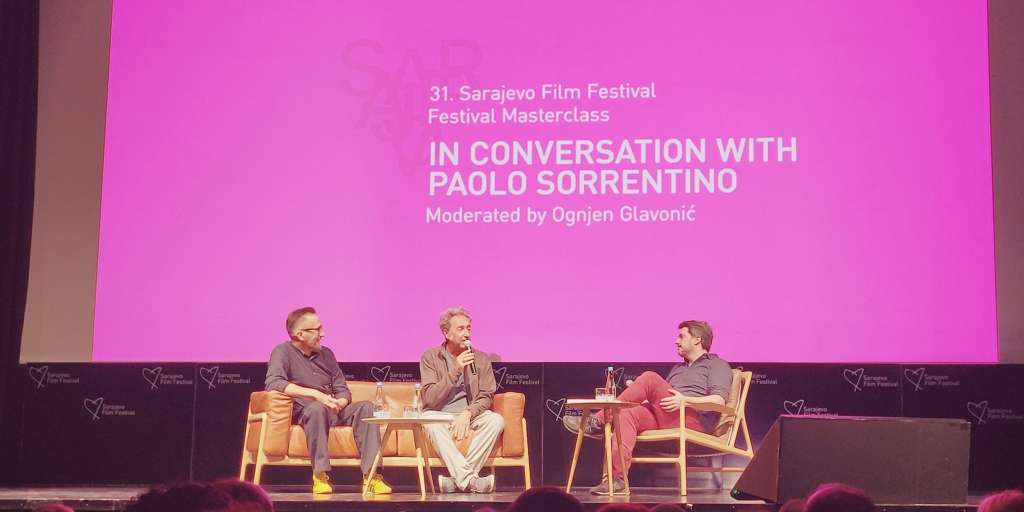
SARAJEVO, August 17 (FENA) – Renowned Italian screenwriter and director Paolo Sorrentino, this year’s recipient of the Sarajevo Film Festival Honorary Heart of Sarajevo for “outstanding contribution to the art of cinema,” held a masterclass this morning at the Bosnian Cultural Center in Sarajevo. During the session, he shared with the audience his reflections on beginnings, the filmmaking process, key ideas and motives, and, as he emphasized, the most important aspect – the emotions that drive him in his cinematic work.

Sorrentino recalled that he began his career as a screenwriter, initially for television.

“I was happy as a screenwriter. I started writing for TV, and at that time, television in Italy was a place of success. I was 24 and rich, so I thought I didn’t need anything else,” he said with a touch of irony, adding that directing eventually drew him in. “I realized it was more fun to be a director than a writer, and I started directing.”

Speaking about his first feature film, One Man Up, he said the project did not bring him “wealth,” but it introduced him to the joy of directing.

He also recalled his early festival experiences: premieres at the Venice Film Festival and invitations to participate in the early years of the Tribeca Film Festival.

“When I first went to Venice, I knew nothing about the world of film… I didn’t understand who the people sitting across from me were. And when the invitation to Tribeca came and someone said ‘Robert De Niro,’ I was convinced the producer was playing a joke on me,” he joked.

He emphasized that he finds “making films more fun than talking about them.”

“I’m happy to be here, but I always think I might be better off making a film rather than talking about films,” he added.

Asked about recurring themes of music and football in his work, Sorrentino explained that he “reserves” these professions for his characters because they were passions of his father. He said he never seriously tried to pursue music or football himself, but both worlds inspire the characters he creates.

He described his approach to developing films:

“I usually start from the characters. I recall and think about people I’ve known in life. Sometimes I combine two, three, or four real people into one character I want to portray. The visual aspect comes later; on set, I better understand the images I have in my head,” Sorrentino explained.

Discussing practical work on set, he spoke without romanticizing the process:

“I don’t like to work much, so I am very fast. I can’t wait to go home. I shoot with three or four cameras and usually finish the film three or four days before the deadline,” he said. Still, he admitted that “what happens on set is always less beautiful than what’s in the idea itself,” because “between your imagination and the result, there are other people.”

On the topic of emotions and “transferring” feelings to the final film, Sorrentino emphasized that films are created from a series of “craft tricks.”

“You have music, actors, camera movement, lighting… many elements that you use like a magician. But there is no real magic; the result of emotions is the result of tricks. The problem is there is no book about these tricks,” he added.

Regarding his film Loro, about the long-standing Italian politician and media magnate Silvio Berlusconi, he said he doesn’t know if Berlusconi ever watched the film or what his reaction was. He explained why the character intrigued him:

“I am lazy and completely the opposite of Berlusconi, a man full of energy and goals. I am interested in the minds of people who are very different from me – the characters I love are always very different from me,” Sorrentino explained.

Discussing the significance of music in his films, he said it “enhances the senses” and accompanies him while writing.

“While I write, I listen to music because it gives me the feeling that I am writing something powerful.” Before digital services, he relied on friends’ recommendations; today, streaming platforms play a curatorial role.

Asked about cinematic influences, he spoke of the legendary director Federico Fellini, highlighting the importance of a constant sense of instability and irony.

“Fellini clearly showed me that one constantly moves in the ‘realm of uncertainty’ – that life is terrifying – and he managed to encompass all that with humor. I try to ‘steal’ that irony and incorporate it into my films,” he explained.

He also touched on narrative choices, such as the idea of “a character returning home.”

“It’s more romantic for a character to return and die at home,” he answered a question from the audience.

Regarding audience reception, Sorrentino stressed that viewers do not need to “see themselves” in a film:

“You have the wrong approach if you look to find yourself in a film. You should try to get to know what is not part of you, what is beyond you. A film should put you in a state where you do not understand everything; films in which you understand everything about the characters and plot in the end – those are commercial films. Arthouse cinema is something else,” he emphasized.

On reading other people’s scripts and what might convince him to direct someone else’s story, he replied that he “tried many times,” but ultimately always refused.

Asked about cynicism in his characters, he said cynical people are “very fragile.”

“Cynicism is a mask that hides fear of life, and when we talk about suffering, all significant films, books, and songs are simply the final result of pain and suffering,” Sorrentino explained.

Discussing his own “sadness,” he said directly: “Films saved my sad life.” When “the sadness becomes too great,” he makes a new film, as the process draws him among people and helps him be “a little less sad.”

On humor in his work, he said he mistakenly believed he was writing “very funny” films, but “in the end, the films turn out slow, sad, and full of despair.”

“If I am ironic, it is because of my city. Naples is a place where people are very witty. But that irony is not simple; vanity is the enemy of irony, and it is not easy to find truly witty actors,” he emphasized.

Addressing the role of film in relation to contemporary tragedies, including the situation in Palestine and the ongoing genocide in Gaza, Sorrentino said films “cannot prevent or cause such events” and that he has no “authority” to speak beyond general observations.

“If you want my opinion, although it is simple and banal: I agree with everyone who says genocide is happening in Gaza,” he said.

On the question of “beauty” in his films, Sorrentino responded skeptically about definitions: “I don’t know what beauty is. I only know what drives me to try to create it – the ability to be amazed. Anything that surprises me is interesting enough to enter the film,” he explained.

At the end of the masterclass, he offered advice to young creators.

“Anyone can make a film if they learn a few key things. But to make a good film, you must nurture talent, align certain aspects of your personal life, be lucky to meet the right people, study, watch films, visit museums, and see the work of great photographers. All of that must come together in a good director,” Sorrentino concluded.

As part of this year’s Sarajevo Film Festival, a retrospective of Sorrentino’s works will be presented in the program Tribute To.

His debut film One Man Up was selected for the Venice Film Festival in 2001. At Cannes, he competed for the Palme d’Or with The Consequences of Love (2004), The Family Friend (2006), and Il Divo (2008), with Il Divo winning the Jury Prize.

He returned to Cannes in 2011 with This Must Be the Place, and two years later with The Great Beauty, which won the Oscar, Golden Globe, and BAFTA for Best Foreign Language Film, as well as three European Film Academy awards.

(FENA) S. R.

Vezane vijesti

The 31st SFF closes tonight: Eight days of film, 227 works and honorary awards

'Our Time Will Come' screened at SFF: An intimate story of love and overcoming obstacles

Ray Winstone to receive Honorary Heart of Sarajevo Award for outstanding acting career

Promo

m:tel na No Limit Festivalu: Priznanja za kampanje koje mijenjaju zajednicu

m:tel: Besplatno zamijenite staru 3G SIM karticu za eSIM

United Group B.V. nastavlja sa snažnim rastom u trećem kvartalu 2025. godine