prijava
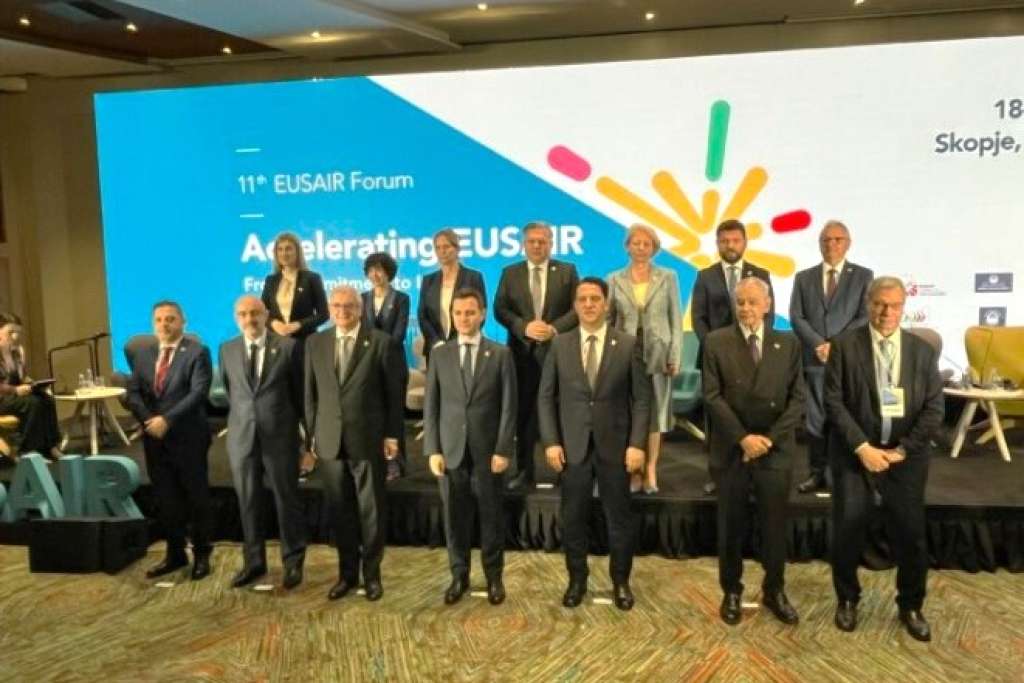
SKOPJE, May 19 (FENA) – Participants of the 11th Forum of the European Union Strategy for the Adriatic and Ionian Region (EUSAIR) today adopted the Skopje Declaration at the conclusion of North Macedonia's presidency of the initiative, reaffirming that EU enlargement remains a geostrategic investment in peace, security, stability and prosperity of the region, alongside a call to accelerate the European integration process of Western Balkan countries.
The declaration was adopted by representatives of Albania, Bosnia and Herzegovina, Croatia, Greece, Italy, Montenegro, North Macedonia, San Marino, Serbia and Slovenia, with the participation of the European Commission.
The document states that accelerating the EU enlargement process must remain a strategic priority for the Adriatic-Ionian region and Europe as a whole, emphasizing that the accession process must be credible, predictable, and based on reforms and fulfilment of each candidate country’s criteria.
Participants called on EU member states to maintain a strong political focus on the enlargement process and ensure a clear and predictable path to membership for candidate countries.
The declaration welcomes the progress made by candidate countries during 2025 and 2026, assessing that macro-regional cooperation through EUSAIR is an important instrument for bringing the region closer to the European Union.
It stresses that EUSAIR cooperation enables gradual integration through joint projects, policy alignment and the use of European funds, particularly through the Growth Plan for the Western Balkans and other EU mechanisms.
Particular emphasis is placed on continued gradual integration of the region into the single European market and EU policies, including the initiative to include the Western Balkans in the ''Roam Like At Home'' regime, which would remove roaming charges between the EU and the region.
Participants underlined that EU enlargement is not only an economic issue but also a matter of political stability and security of the European continent.
The Skopje Declaration dedicates significant space to the international security situation, noting that Europe is facing an increasingly complex and unstable geopolitical environment.
Concerns were expressed over the consequences of the war in Ukraine, rising tensions in the Middle East, and other security challenges that threaten European and global stability.
Participants reiterated condemnation of Russia's aggression against Ukraine, describing it as a serious violation of international law and the foundations of international security.
At the same time, support was reaffirmed for Ukraine's sovereignty, independence and territorial integrity within its internationally recognized borders, as well as for its recovery, modernization and reconstruction.
The Declaration supports continued diplomatic efforts aimed at achieving a comprehensive, just and lasting peace based on the principles of the UN Charter and international law.
A significant part of the document also addresses developments in the Middle East.
Participants expressed serious concern over escalating tensions in the region, including developments related to Iran, and called on all sides for maximum restraint, protection of civilians and respect for international law.
Diplomatic efforts to ensure freedom of navigation and protection of key trade and energy routes were supported, given their importance for global trade and energy security.
The declaration also supports the implementation of a sustainable ceasefire in Gaza and calls for unhindered access to humanitarian aid for the population.
Participants reiterated support for a two-state solution, Israel and Palestine, as two independent, sovereign and democratic states living side by side within secure and internationally recognized borders.
Concern was also expressed over the worsening humanitarian situation in Lebanon, with a call to protect civilians and continue diplomatic efforts to end the conflict.
A large part of the Skopje Declaration is dedicated to regional cooperation, infrastructure connectivity and strengthening the resilience of the Adriatic-Ionian region.
Participants confirmed that EUSAIR remains a strategic framework for cooperation between EU member states and candidate countries, aligned with EU policy priorities and multiannual financial frameworks.
The Strategy is described as an important platform for political dialogue and policy coordination, enabling countries in the region to respond jointly to challenges rather than through fragmented national approaches.
The declaration highlights the importance of transport, energy and digital connectivity in the region.
In this context, the signing of a memorandum of understanding under the ''Green Lanes'' initiative between Western Balkan countries and neighboring EU member states was welcomed, aimed at speeding up the flow of goods and people across borders and strengthening regional trade.
The document states that EUSAIR can play an important role in connecting Europe with Asian markets through the development of strategic energy and transport corridors, including the Vertical Gas Corridor and the India–Middle East–Europe Economic Corridor (IMEC).
The need for stronger cooperation with other European regional initiatives, including the EU Strategy for the Danube Region and the Three Seas Initiative, was emphasized.
Participants also highlighted the issue of professional truck drivers in relation to the implementation of the EU Entry/Exit System, noting the need for a joint solution to facilitate transport and trade between the EU and Western Balkan countries.
A significant part of the Declaration addresses the future of the EUSAIR Strategy itself and its financing after 2027.
Participants supported the integration of EUSAIR priorities into future EU financial instruments and programs, including cohesion policy, Interreg programmes, IPA III, the Western Balkans Investment Framework, and the EU's future multiannual financial framework for 2028–2034.
The European Commission was urged to continue providing strong political and operational support for the implementation of the Strategy's priorities.
The Declaration welcomes the revised EUSAIR Action Plan from 2025, which introduced a fifth pillar on social cohesion and further emphasized EU enlargement, digital transition, economic development and regional resilience.
Participants assessed that strengthening multi-level governance and cooperation between European, national, regional and local institutions is key to successful implementation of the Strategy.
Special emphasis is placed on the role of local and regional authorities, academia, civil society and business chambers in implementing EUSAIR priorities.
The Declaration highlights cooperation with universities, NGOs, cities and the business community as essential for the sustainability and visibility of the Strategy.
Participants praised the work of the Adriatic-Ionian forums of cities, chambers of commerce and universities, noting their key role in connecting institutions and citizens in the region.
A large part of the document is also devoted to youth, demographic challenges and population outflow from the region.
Participants warned that the future of the Adriatic-Ionian region depends on the ability of states to provide young people with quality education, employment and prospects to stay.
They called for increased investment in education, skills development, labour mobility, innovation and entrepreneurship.
The declaration supports continued youth-focused projects, including the EUSAIR POPRI Youth programme and activities of the EUSAIR Youth Council.
Such initiatives are described as an important response to brain drain and demographic decline in the region.
Participants also welcomed initiatives related to scholarships, internships and support for secondary school youth projects in the Adriatic-Ionian region.
The Declaration also confirms the importance of parliamentary cooperation within the Adriatic-Ionian Initiative.
It welcomed the Conference of Speakers of Parliaments of the Adriatic-Ionian Initiative held in Skopje in April this year, which discussed peace, stability and regional connectivity, including Corridors VIII and X.
At the end of the document, participants congratulated North Macedonia on its successful presidency of the Adriatic-Ionian Initiative and EUSAIR, noting significant progress in strengthening regional cooperation and the European perspective of the region during its one-year mandate.
It was also confirmed that Italy will assume the one-year presidency of EUSAIR from 1 June 2026 to 31 May 2027, with expectations that it will continue to strengthen regional cooperation, connectivity and European integration of the Adriatic-Ionian region.
(FENA) A. B.